
Public transportation can be vital to a community because it acts as a third space where communities can come together outside of work or home.
Cathy Michael is a research and instruction librarian at Ithaca College who uses the TCAT daily to get from her home to campus. Michael says one of her favorite parts of using the bus is in meeting new people and expanding her community.
“The nicest thing about the bus is it gives you a sense of community,” Michael said. “You get to know the same people that take the bus with you. That’s a neat thing.”

Cooperation
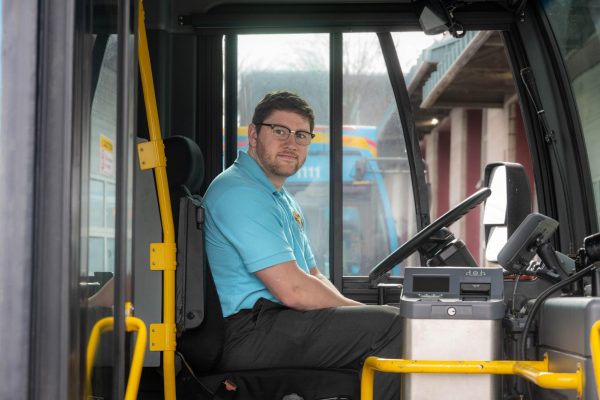
The Tompkins Consolidated Area Transit(TCAT), has had a long and cooperative relationship with Ithaca College, with their relationship growing even stronger after a 2023 agreement gave students and faculty a fully subsidized fare.
For many years, Ithaca College and the TCAT worked together to fully subsidize th
e TFare for all IC employees, and have a reduced fare for students. This was done through students buying bus passes, at a reduced fee once showing their Ithaca College ID, and then TCAT would invoice IC the remaining fee. This system proved to be difficult for both sides, as it created a lot of work for TCAT, and a lack of information for the college on who was riding.

Tim Downs, the senior vice president and chief financial officer of Ithaca College said due to the struggles with the original system, the College and TCAT decided to work together and create a better system.
“It was pretty clunky, a lot of work for them, a lot of tracking down for us and a lot of unpredictability,” Downs said. “So we reached out to them and said, ‘Why don’t we build a better process?’”
A solution
TCAT launched the idea of using the TFare app, a mobile app that can be filled with money to easily use to pay for the bus fare.
IC and TCAT worked together to get this off the ground, using the negotiations as an opportunity to test the program.
With the app, IC could track the exact number of students and employee riders, and use that data to set up a flat fee deposit to cover the fare for all students and employees.
Matthew Rosenbloom-Jones, general manager of TCAT, said the relationship is beneficial for all involved, from students and faculty, to both the TCAT and the College.
“It’s a really good partnership for us, and of course, for the college; it means they have a happy student body,” Rosenbloom-Jones said. “It also means that not as many students have to own cars, which means less parking needs. It benefits everyone really.”
Although the new system of subsidizing the fare for all students and employees is beneficial for all sides, Ithaca College has been working to reduce their budget deficit for the past few years, hoping to get it from $9.6 million at the end of the 2025 fiscal year to $4 million by 2027. As such, many majors, clubs, and programs on campus have experienced budget cuts as the college works to reduce the budget deficit.
As such, students and faculty may worry about the status of IC’s current relationship with TCAT in the face of budget cuts throughout the college.
Downs said while that may be a worry down the line, IC would work with TCAT to find a solution that works best for all, with certain bus lines or times being cut before they consider stopping the fully subsidized fare.
“If we can’t get everything, let’s get the best of what we can to make sure it works for us, it works for them and it’s a healthy relationship.” Downs said.
Thriving relationship
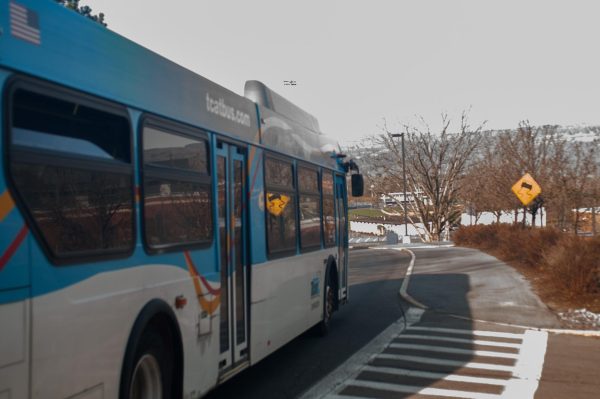
In the years since the new system between IC and TCAT, ridership has increased greatly. According to TCAT data, before the fully subsidized fare for students, bus route 11, which goes from IC to the Commons, had 2,990 riders in January 2022. In January 2025, two years after the new system was implemented, there were 8,416 riders.
Downs said he is thrilled to see ridership increase on the TCAT, and that he hopes the relationship between the college and the bus system will continue to thrive.
“I believe, for any community to thrive, it needs a healthy ecosystem…that allows that community to thrive and grow,” Downs said. “Public transportation is a key part of that. We wanted it to be successful, and now we get to contribute to that, because when we drive ridership up…it puts more into the bus system.”