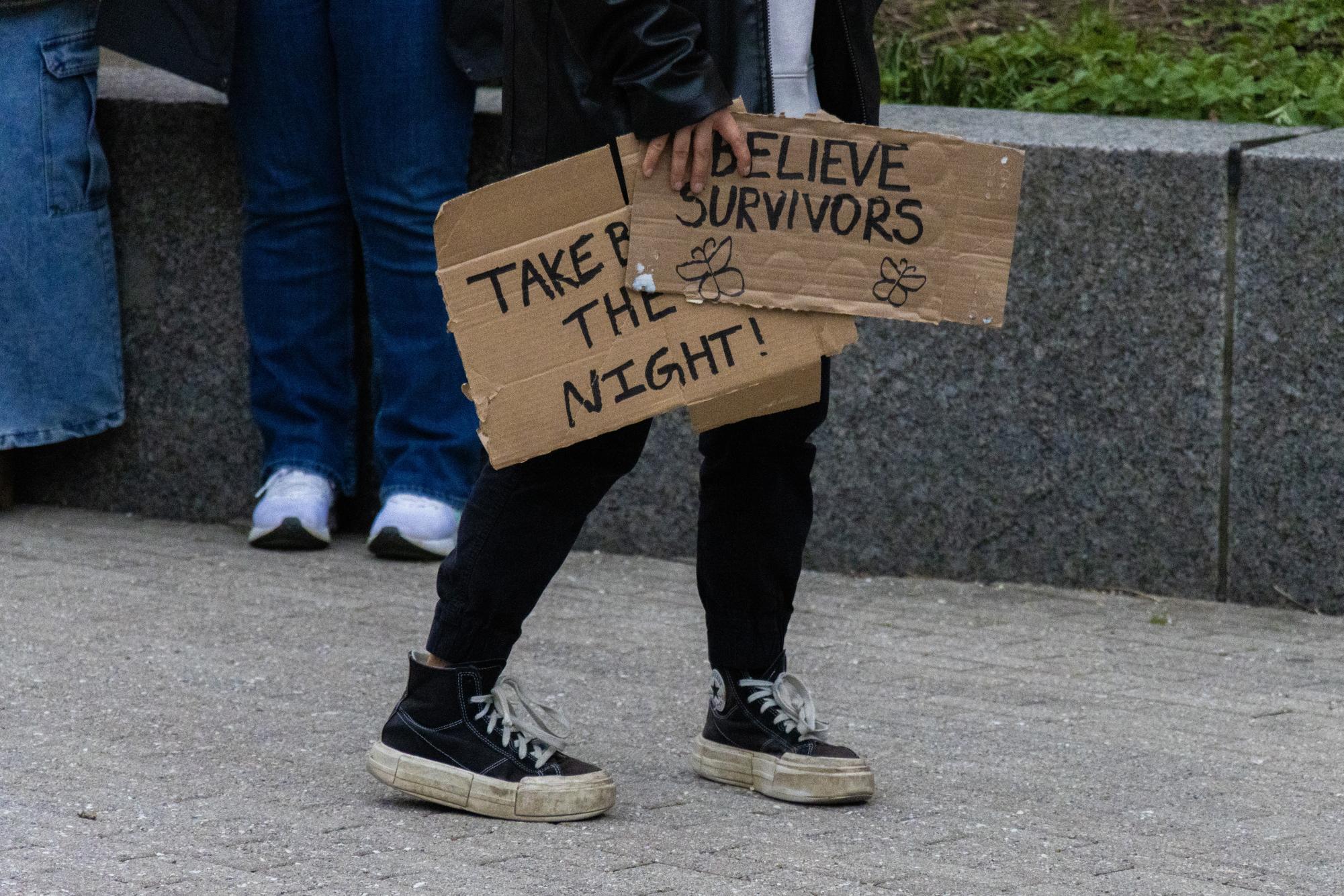
Chants echoed down Ithaca’s South Aurora Street as students marched from the Ithaca College campus down to The Commons for the Take Back the Night rally and vigil April 24 in support of survivors of sexual and domestic violence. From colorful posters to powerful songs, the event connects survivors and supporters through displays of artistry and vulnerable self-expression.
TBTN is a global movement to end all forms of sexual violence and support survivors. TBTN provides legal support, fosters community organizing and works to educate the world about the prevalence of sexual violence. They found that 1 in 3 women worldwide experience some form of sexual violence or intimate partner violence in their lives, and less than 50% of victims report sexual violence crimes.
The Advocacy Center of Tompkins County hosted Ithaca’s 47th annual TBTN rally and vigil. Claire Hansen, Community Educator at the center, said the theme they chose for the 2026 TBTN is “Give us our roses, too,” inspired by a poem by James Oppenheim.
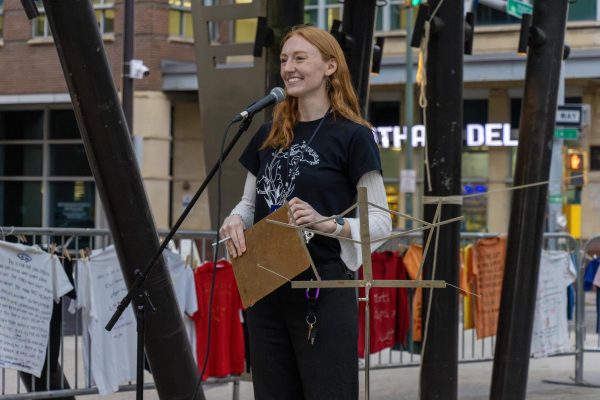
“The specific theme of Ithaca’s Take Back the Night this year is this idea that survivors deserve more than just to survive,” Hansen said. “They deserve to be respected. They deserve to feel empowered. And they deserve to not have to constantly fight for their rights.”
Students from Ithaca College and Cornell University marched down to The Commons from their respective campuses, and community members marched from the Greater Ithaca Activities Center.
Women have been rallying together in opposition to gender-based violence since the 1970s. Hansen said each year brings new perspectives and issues to the table based on the current political climate.
“Right now, we’re living in such a tumultuous, divisive society where there’s so much division based on belief and division based on experience, and Take Back the Night is the counter of that,” Hansen said. “We’re coming together, supporting the experiences of these people, believing them and talking about our shared experiences.”
As the sun slowly set, survivors took turns speaking, singing and reading poetry that captured a piece of their story and emotions.
Solidarity, community
Jane Wang, a first-year student at Cornell, shared her experience by telling the story of her experience with sexual violence, but also how that has pushed her to be part of the legal advocacy space. Wang shared that she was drugged and raped by her mother’s boyfriend — someone she thought she could trust — when she was 16 years old. She said that speaking at TBTN was her first time sharing her story.
“Knowing that Ithaca has created a space for survivors and for victims to be able to come together and share their stories, and seeing so many people have come to stand in solidarity, helps so much,” Wang said. “I was moved to tears so many times.”
Feeling isolated is a common feeling after experiencing sexual violence, whether it be because they feel like they can’t share their story with someone or because the abuser is actively isolating them. Wang said she felt isolated after her assault, but has found community in Ithaca with the Advocacy Center and others.
“When you’re able to zoom out and realize, ‘wow, this issue is so much bigger than me,’ it makes you feel so much less alone,” Wang said. “It’s one of the things that motivates me to want to pursue work in civil rights and protecting victims.”
Sexual violence is an underreported crime in the United States. This is partially due to the U.S. legal system not being structured to support survivors of sexual violence. Barriers with the burden of proof, the Statute of Limitations and sexist court officials all can prevent survivors from obtaining legal justice.
Personal experience
Anna Kelles, New York state Assemblymember for Tompkins County, spoke at the event to provide a political perspective. She originally planned to speak just about initiatives and numbers, but felt inspired to share her story after watching multiple vulnerable performances. Kelles said that she is a survivor of sexual and domestic violence.
“To have the personal experience, and to know what that’s like, and to feel the journey of rediscovering that self-love, and that power, and that place, and that voice, is a really powerful experience,” Kelles said. “When I go to the state, I am very OK looking people in the face and saying, ‘I’m a survivor,’”
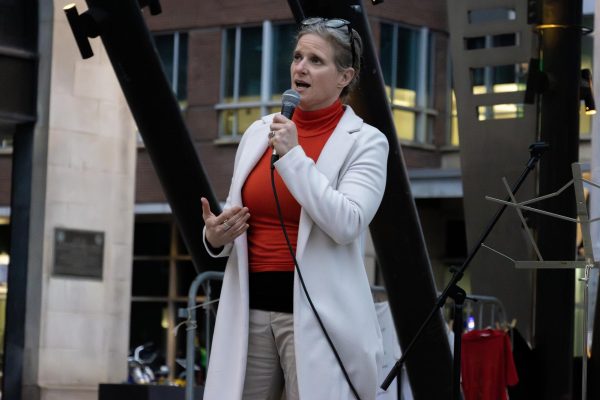
Kelles said she has been working with her team on initiatives to support survivors. She said the federal government cut millions of dollars intended to support nonprofits, but New York state put $150 million into its state budget to counteract that.
“I want everybody to hear this because I want you to know that we are everywhere,” Kelles said. We are teachers. We are elected officials at the state level at the federal level. We are students. We are we are everyone.”
Each attendee received a candle at the end of the night for the vigil. A row of candles lined the front of the Bernie Milton Pavilion on The Commons as community members from across Ithaca gathered in silence to remember the thousands of lives that are lost to sexual abuse every year.
While the event focuses on heavy themes, the night ended with a performance by the Cornell Pole Posse as a way to end on a note of joy and feminine power. The Pole Posse aims to promote body confidence and honor the origins of pole dancing.
“The goal is for people to leave feeling a sense of empowerment, a sense of strength, but also a deep sense of hope for the community and the world at large,” Hansen said. “If people can come together all over the country in support of these issues and in support of survivors, then it’s not all hopeless.”


