
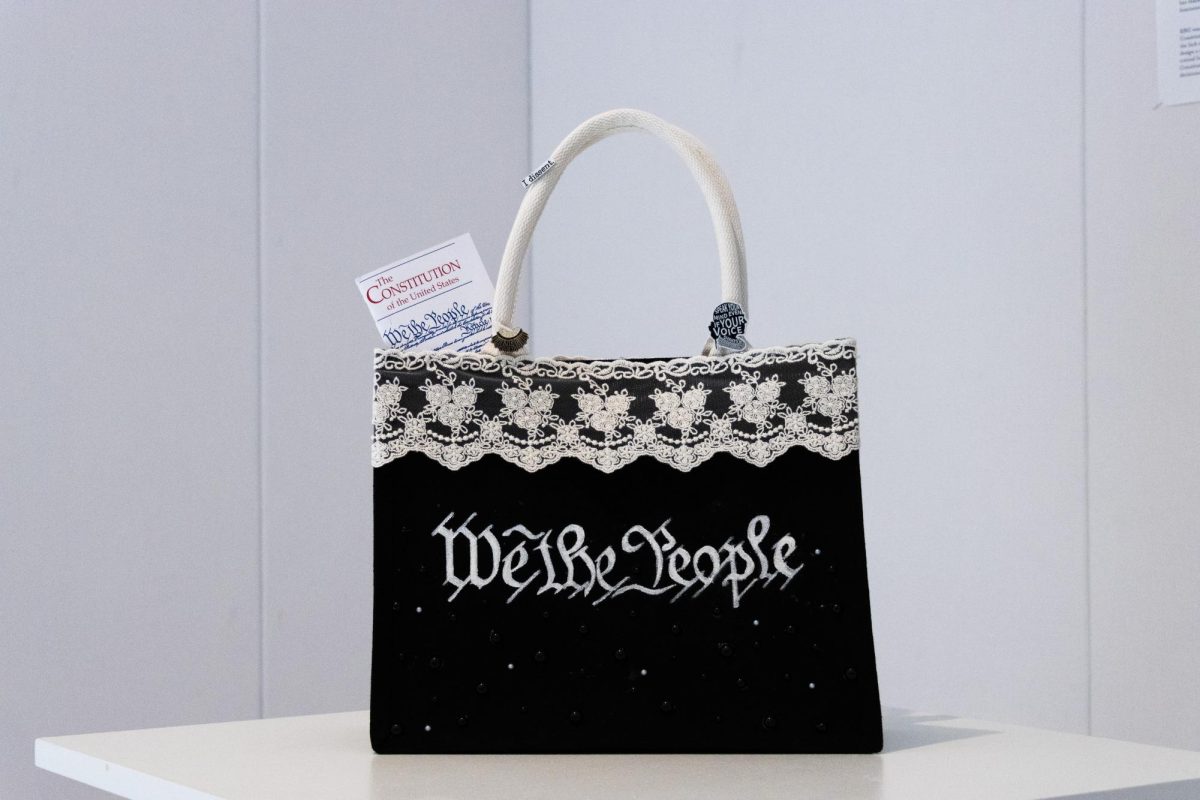
Everywhere she went, former Supreme Court Justice Ruth Bader Ginsburg brought a pocket sized copy of the United States Constitution in her handbag. Ginsburg’s embodiment of the intersection between fashion and law inspired the creation of one of Cornell Human Ecology’s newest exhibitions: “Fashioning Justice: Ruth Bader Ginsburg ’54 and the Power of Presence.” The exhibit will be open through Oct.1.
The series of art, artifacts and research all tell the story of Ginsburg and how she used fashion as a way to express femininity and resistance. On April 14, Cornell University hosted an event featuring guest speaker Clara Spera, Ginsburg’s granddaughter and reproductive rights advocate, and a screening of “Making the Case: A Supreme Court Justice and Her Bags” directed by Jennifer Callahan.
Judicial robes and gender
Ginsburg understood that fashion is communication. Often the message she was communicating connected to her gender and her role as a trailblazer for women in law. The exhibit was curated by students in the Fashioning Justice course which was led by two Cornell University professors: Denise Green, Lau family associate professor and director of graduate studies in fiber science and apparel design, and Kristen Underhill, associate dean for faculty research and professor of law.
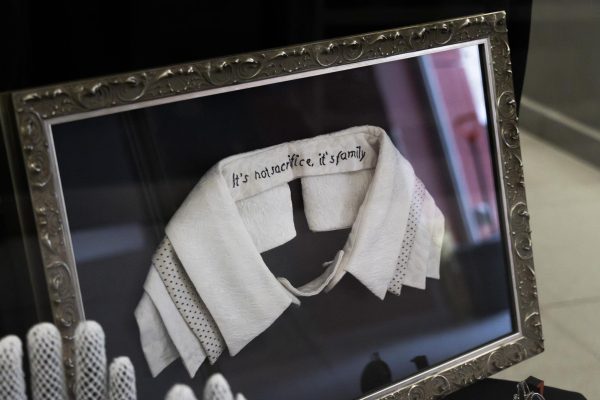
Green said she found in her research that because Ginsburg and Sandra Day O’Connor were the first two female Supreme Court justices, they wanted to find a way to bring a feminine detail to the judicial robes.
“The judicial robe was designed for a man, and by bringing that emphasis, they are revealing that fact right to the public, that they’re not wearing a tie, not wearing, you know, a shirt collar, but they are wearing a big, lacy, jabot collar, and using materials that reference femininity,” Green said.
Fashion weaponized
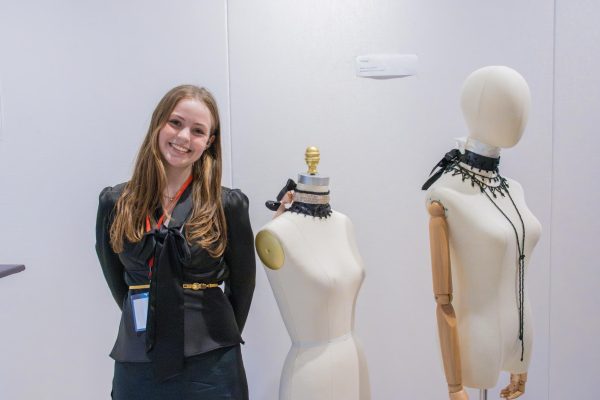
Sophomore Dani Mendell, art history and business double major, said she researched writing that Ginsburg did on the right of search and seizure and how that connects to the importance of handbags. She also created an exhibit for accessories.
“I made a collection of embroidered chokers and necklaces because when I think of her choker, I think of using it as a way to make a statement, whether she’s dissenting or saying an opinion,” Mendell said. “And for me, wearing jewelry is like my version of a statement.”
While women’s fashion has often been celebrated as a way to express femininity, it has also been weaponized. What a woman wears can be used against her in cases of sexual violence, resulting in victim blaming.
“A lot of the victim blaming that goes on today is because people seem to have an inability to accept the reality of the way that women are still treated today,” Mendell. “Despite the fact that we have all these rights today, there are still these underlying, more hidden levels of sexism.”
A grandmother’s legacy
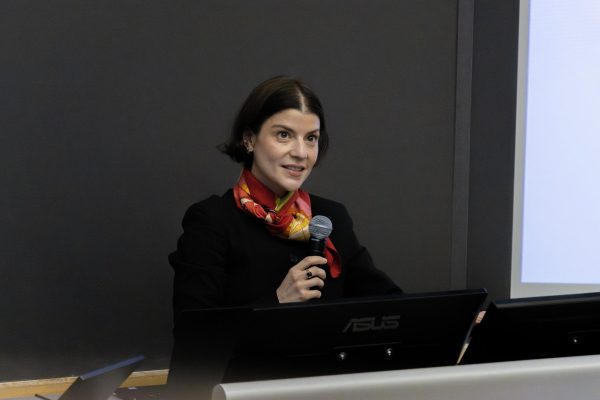
During Spera’s presentation, she pointed out her scarf: a piece that used to be in her grandmother’s closet. She said Ginsburg was always intentional with the clothes she wore because, in a courtroom that was watching whether women belonged there at all, what she wore was a part of her message.
“As someone who works in reproductive rights, the area of law where one’s body and the ability to control it is the central question,” Spera said. “This framework is especially resonant to me. Bodies are never just bodies. They are always sites of meaning, of contest, of power. My grandmother understood that.”
Women’s bodies and clothing choices have also been inequitably regulated in school and work environments. In the 2015 case of Equal Employment Opportunity Commission v. Abercrombie & Fitch Stores, Inc., a woman sued the company for not hiring her because she wore a hijab. Women in schools also face different dress codes because certain styles may “distract male classmates.”
“Part of what RBG did is ensure that people have a say in workplace dress code and that it’s not disproportionately affecting and harming one group over another, so that we all can have access to this language and the ability to use it,” Green said. “It’s a very important medium, especially for those who have had their voices silenced.”
The exhibit will be open through October 1 and is located in the Rachel Hope Doran ‘19 and Terrace Level Display Cases in the Cornell Human Ecology Building.


