New York’s state budget process could push through $30 million in direct payments for specialty crops, livestock producers and aquaculture this month — a first-of-its-kind appropriation branded as relief from President Donald Trump’s tariffs.
Introduced by Gov. Kathy Hochul in her executive budget in January, the Agricultural Resiliency Against Tariffs Program “helps safeguard agricultural operations and ensure stability in a volatile global marketplace.”
State officials say the program comes at a critical moment. Farmers have been affected by rising costs tied to agrochemical imports and tariffs on 70% of farm machinery imports. At the same time, milk exports declined 12% in the first half of 2025, says the state comptroller’s federal impact report.
The state proposal arrives alongside federal relief. The Farmer Bridge Assistance Program rolled out in 2026 included $11 billion for grain commodities, already en route to farmers. By contrast, $1 billion for specialty crops — requiring acreage documents to be submitted by April 29 — has drawn criticism, with industry groups saying the federal $1 billion is not enough.
“Although the United States Department of Agriculture recently announced a national assistance program, it is fundamentally flawed for New York since it leaves specialty crops and the dairy sector with no meaningful support,” Hochul said earlier this year.
New York’s plan was introduced before federal relief details were finalized, creating an overlapping safety net. As written, the state program would support livestock producers (predominantly dairy) and specialty crop growers who did not apply for USDA funds.
But the bill text leaves key questions unanswered. No eligibility metrics have been identified and payments cannot overlap with USDA’s Assistance for Specialty Crop Farmers (ASCF) Program.
The need for New York’s program hinges on how effectively growers applied for federal ASCF dollars. Civil Eats reporting showed small farmers described the reporting requirements as “onerous,” prompting USDA to reopen applications through April 24.
Jeff Hurtgam, a vegetable farmer in Niagara County, described the stack of documents he brought to his local farm service office to apply for the ASCF. “Crop map from last year, acreage, planting dates. Then I had to give them some proof of production like a couple seed bills, fertilizer bills, some receipts from one of the accounts,” he said.
A former Farm Service Agency county board member, Hurtgam said that with more time, his neighbors are adding their applications.
In the state proposal, grain crops do not qualify — though they were supported by $11 billion from the first Farmer Bridge Program — despite likely being integrated into livestock operations, as 45% of corn is used for silage feed.
However, state legislators are not completely aligned on the proposal. Some senators have left it out of their appropriation announcements and farm groups aren’t commenting on its effectiveness until it is finalized.
Lack of information
After being proposed, both Democratic chambers advanced the measure in their one-house budget bills, where it remains unchanged in the Aid to Localities section.
Assemblywoman Donna Lupardo, chair of the agriculture committee said she ultimately wants broader coverage.
Aid should go to “everybody who got hurt, just as long as we’re not people who aren’t benefiting from both programs,” her office said. Right now, grain crops remain excluded but who is included in the aid could change if passed.
“We want to make up for losses. It shouldn’t be a windfall,” they said.
State agencies have offered limited clarification. In response to a list of questions, New York Agriculture and Markets said, “The Governor proposed the Tariff Relief Program in her Executive Budget to offset rising costs for our farmers due to federal tariffs. The Department will have additional details on the program and coverage once the State Budget is passed.”
But the program also reflects a broader political stance. Hochul has been outspoken against Trump-era tariffs, proposing not only farm aid but also $13.5 billion in returns for all New Yorkers, based on an estimated $1,751 in added costs per household.
In his joint budget hearing testimony, Agriculture Commissioner Richard Ball framed the effort as both policy and signal: “This is an attempt…for the governor to send a signal that she’s investing in agriculture and wants us to continue to do the same.”
The proposal text itself does not explicitly mention tariffs.
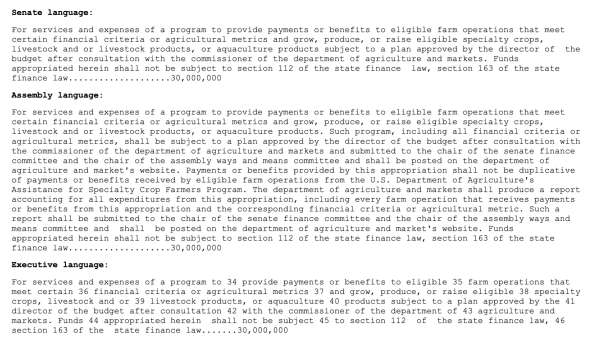
Fiscal think tank leader and president of the Empire Center, Zilvinas Silenas, questioned that gap: “If what you say to the media and what you have in the bill doesn’t match. Now that raises a whole lot of additional questions. Laws and payments go by bill language, not by what was said in the media.”
That skepticism is shared by some Republican lawmakers as well.
Assemblyman Chris Tague told the TimesUnion that, “The governor needs to be careful because I don’t think she knows farmers very well. Farmers aren’t about handouts. Farmers just want a fair and level playing field to be able to play on.”
For now, major farm groups are taking a wait-and-see approach. The budget proposal has appeared on New York Farm Bureau’s priorities list, but the organization said, “We won’t have any real information on that until the program is put in place, provided it passes in the final budget,” Amanda Powers, director of communication for NYFB, told Ithaca Week.
The budget is now in its third extension phase, with a deadline of April 16th. “I could jest that the entire New York budget process is definitely lacking transparency,” Silenas said.
Do farmers need it?
Those involved in the industry walk a line between aid payments and long-term solutions to high input costs and low prices.
One 30-acre western New York specialty crop farmer who wished to stay anonymous due to speaking about his finances and those of his neighbors said, “I can’t think of a situation in our area where a farmer goes out of business, besides their age. The farm would continue without it (farm aid payments).”
Support like this has never been routine and feels new to their operation, they said. The farm took advantage of both Coronavirus Food Assistance Program payments and just received access to federal crop insurance in 2020.
Quantifying tariff impacts for some New York farmers is difficult. The farm applied for ASCF bridge payments and, as currently written, wouldn’t qualify for New York’s future payments.
“I think here, we will consistently get a good price for things. We’re not competing with California. We have a lot of small growers,” they said.
When asked what the current bridge payment would go to: “summer farm labor,” the operation said.
The other program audience, dairy producers, has faced a 75-year low in milk prices. But while advancing this aid, the administration has also highlighted a dairy boom, emphasizing processing-sector growth and optimism rather than the downturn cited in this relief package.
Much of the discussion centers on New York’s North Country or Adirondack region, which borders Canada. Each farm cited by Commissioner Ball was seeing tariff impacts just miles across the border. Canada is New York’s top foreign trade partner, importing $2 billion in agricultural products.
A state role in a federal process
Another large fruit grower in western New York explained that tariffs are not directly hitting the apple industry. “New York apples don’t rely on a huge amount on export markets,” they said.
But the indirect tariff effect, they explained is, “Washington apples which have a big oversupply situation. If they were planning on exporting — call it 10 to 15 million boxes, the tariffs had basically shut down those markets. That all gets rerouted into the domestic market. So then it just gets flooded.”
This operator also applied for Bridge Payments, saying there was “a mad dash across parts of the country for specialty crop growers to get signed up with FSA, because there just wasn’t a relationship.”
But specialty crops, compared to his grain crops, have received three to five times larger payments. The ad hoc payments, based on actual acres planted rather than base acreage, represents a positive shift for federal farm policy. Younger farmers are often disadvantaged by their current base acre reporting, which was last set in 2014.
“I think I’m starting to see the tide change on federal specialty crop assistance programs,” he said, noting that specialty crop growers are finally getting more attention.
Two other states are exploring similar legislation. In Tennessee, Senate Bill 2687, the Tennessee Agriculture Recovery and Investment in Family Farm (TARIFF) Relief Act, would create a fund to support farmers impacted by tariff-related costs and losses. In Michigan, Gov. Gretchen Whitmer signed an executive directive to assess tariff impacts.
Outside the agriculture sector, Silenas questioned the program’s fiscal placement in the budget.

“If this state is trying to compensate certain businesses for the damage that the federal government did, right…Is that going to be all businesses? Are all businesses going to get the same treatment? I mean, not just agriculture, but let’s say retail, manufacturing,” he said.
New York has a reputation for high spending, which his think tank argues moves the state back in financial progress. “New York is suffering not from lack of money. New York is suffering from poor spending of money. A problem arises which is going to spend more and maybe it worked in the past, but it is definitely not going to work in the future,” he said.
The apple farmer added that the ad hoc, one-time payments remain limited in impact: “I don’t think that’s really necessarily helping us or moving the needle necessarily.”
And in New York’s case, “It just doesn’t seem like a fiscally responsible way to approach,” he said.
The commissioner acknowledged that some details were intentionally left vague due to the real-time, chaotic federal environment.
But federal farm leaders may already be moving beyond New York’s proposed aid, requesting additional support for fertilizer and fuel impacts from the Iran war, amid ongoing Farmer Bridge Assistance payments and the state’s proposal.